
The Growing Opportunity in Industrial Safety Solutions Serving Critical Infrastructure
Secular growth drivers and mission-critical applications are priming industrial safety market for continued investment and innovation.
Key Takeaways
Industrial Safety is a Large, Non-Discretionary and Growing Market
Several structural tailwinds have accelerated growth in pockets of the market such as industrial manufacturing and power generation.
Critical-Infrastructure Construction Is a Powerful Demand Driver
Much of the safety opportunity is anchored to the build-out of critical U.S. infrastructure.
Investing Behind Safety
The industrial safety market continues to create compelling opportunities for founder-led businesses serving mission-critical markets.
Baird Capital sees tremendous opportunity in the industrial safety market serving critical infrastructure, where demand is non-discretionary and the cost of failure far outweighs the cost of safety solutions. Combined with relevant investment experience in industrial safety with our historical investments in autoLOTO, Cleanwater1 and Justrite; we are well positioned to utilize our experience to assist founder-owned businesses in scaling.
Industrial Safety is a Large, Non-Discretionary and Growing Market
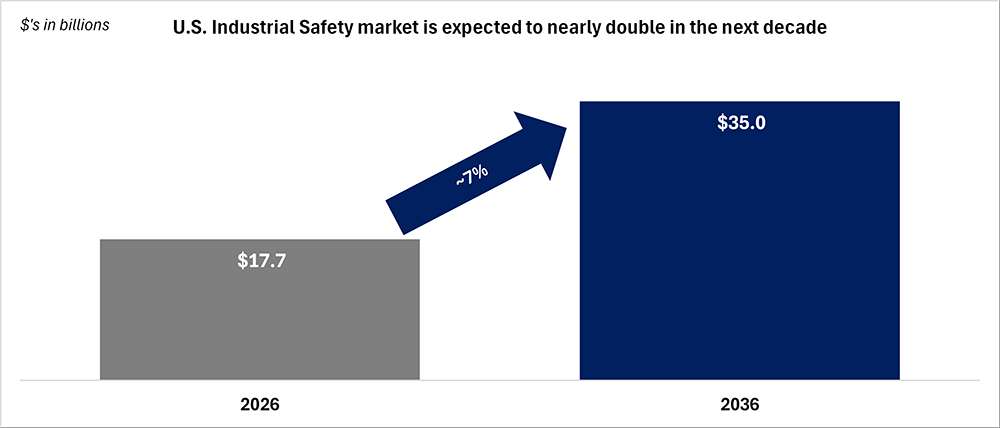
With U.S. work-related injuries costing an estimated $181.4B in 2024 there is consistent demand to improve worker safety. The U.S. industrial safety market is estimated at approximately $17.7B and is expected to roughly double in size over the next decade.1, 2 Within this expanding industry, several structural tailwinds have accelerated growth in pockets of the market such as industrial manufacturing, power generation, water/wastewater, semiconductor, and electrical transmission and distribution.
1Fact.MR, “Industrial Safety Products Market”
Critical-Infrastructure Construction Is a Powerful Demand Driver
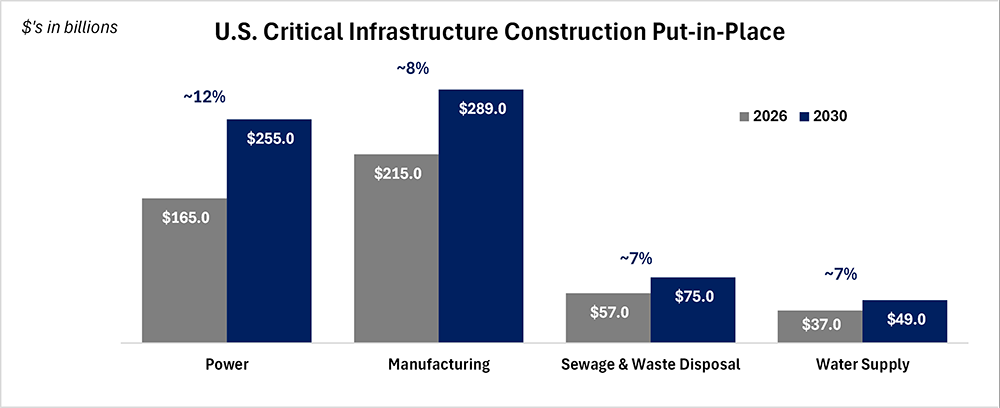
Much of the safety opportunity is anchored to the build-out of critical U.S. infrastructure. FMI's Q2 2026 North American Engineering & Construction Outlook projects total construction put-in-place holding near $2.2 trillion in 2026 before accelerating past $2.7 trillion by 2030 – with growth concentrated in the safety-intensive infrastructure segments our thesis targets.2
- Power — construction is projected to rise from ~$165B in 2026 to ~$255B by 2030 (~12% CAGR), driven by surging electricity demand from data centers and industrial load; utilities plan more than $1.1 trillion of capital spending through 2029
- Manufacturing (semiconductors, chemicals, batteries) — totals ~$215B in 2026, expected to grow to ~$289B by 2030 as reshoring investment continues into highly safety-intensive facilities
- Water & wastewater (the most consistent infrastructure growth) — sewage & waste disposal is expected to climb from ~$57B to ~$75B and water supply from ~$37B to ~$49B by 2030, propelled by water quality strains, lead-service-line replacement, and reuse demand from data centers and advanced manufacturing
- Data centers — now more than half of private construction, with data center starts up ~100% year-over-year, pulling through power, water, electrical and mechanical safety needs across both construction and operations
In aggregate, infrastructure related construction is projected to grow from ~$843B (2026) to ~$1.06T (2030), while nonbuilding infrastructure is expected to rise from ~$414B (2026) to ~$560B (2030) representing a multi-year wave of safety-critical work across electrical, mechanical, facility, and water systems.2
Where We See Opportunity in Industrial Safety
Within the broader industrial safety market, we see several subcategories where there is significant growth potential across both product and service solution sets that are poised to benefit from ongoing investment into critical industrial infrastructure.
Product solutions: We are focused on mission-critical, compliance-driven product categories with recurring demand and defensible differentiation:
- Hazard detection & management — gas and hazardous-energy detection, monitoring and connected-worker devices, supported by a recurring calibration and service base
- Electrical & mechanical safety — electrical and mechanical safety control solutions and lockout/tagout
- Facility & site safety — spill containment, flammables and hazardous-material storage, safety showers and eyewashes, signage/labeling and ground protection
- Water & environmental safety — water quality, treatment, and filtration that protect critical infrastructure
Service solutions: Equally compelling is the recurring revenue service layer that surrounds these products, deepens customer relationships and raises switching costs:
- Calibration, testing & equipment service — recurring maintenance, testing and calibration services tied to a mission-critical installed base
- Audits, training & certification — inspection, compliance training and certification services driven by regulatory-driven demand drivers
- Compliance & EHS— OSHA recordkeeping, ESG reporting and internal safety scorecards
- Monitoring- & safety-as-a-service — subscription models that convert episodic product sales into contracted, recurring revenue
Investing Behind Safety with Baird Capital Global Fund III
The industrial safety market continues to benefit from durable tailwinds, including infrastructure investment, increasing regulatory requirements and growing demand for solutions that improve workplace safety and productivity. We believe these trends create compelling opportunities for founder-led businesses serving mission-critical markets.
Following the successful close of Baird Capital Global Fund III at its $450 million hard cap in April 2026, we remain focused on partnering with founders to scale the next generation of industrial safety leaders.
Connect with a member of the team to learn more.



Related Links


Baird Capital Partners Europe Limited is authorized and regulated by the Financial Conduct Authority.